
Carbon Capture and…When is a Tree not a Tree?
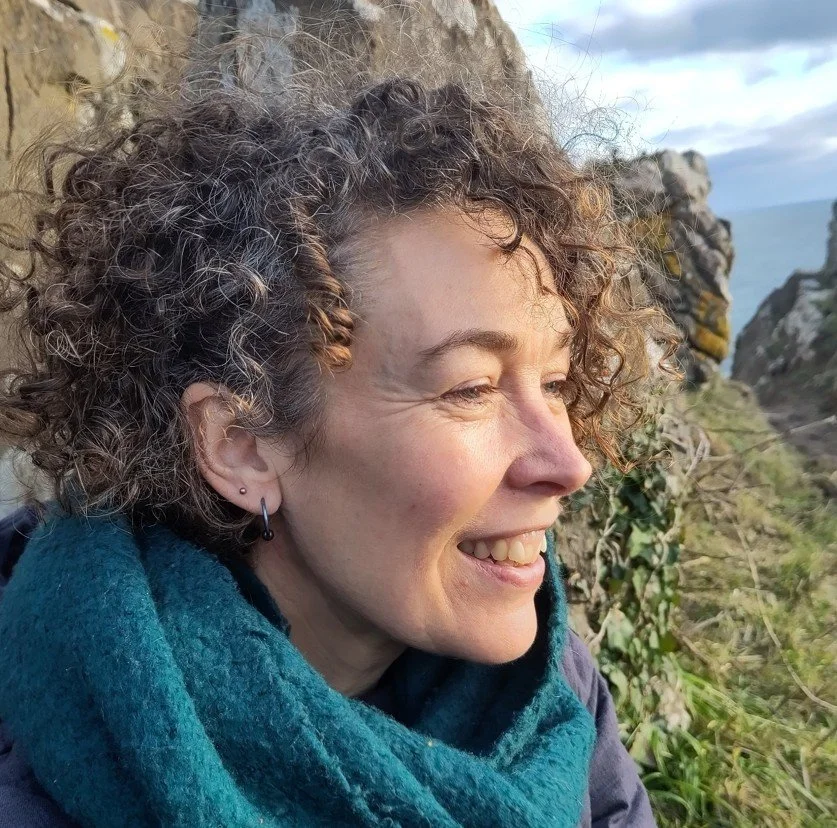
Written by Laura Sky on the Hill at Bowden Pillars
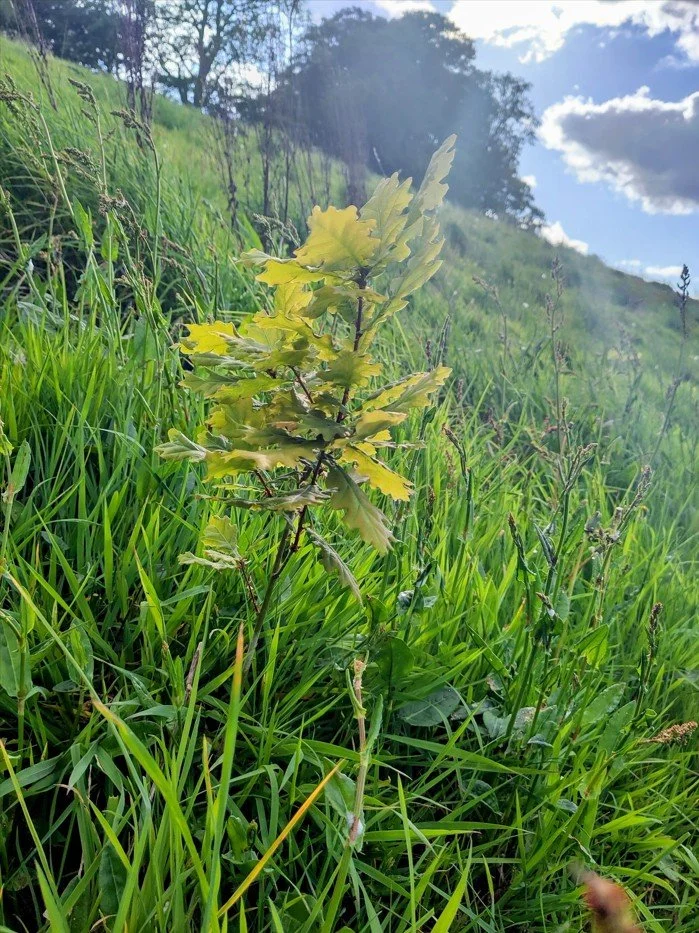
Young self seeder oak on Hill at Bowden Pillars
I am sitting beside a fresh young Oak sapling, growing wild, up on the Hill at Bowden Pillars Future and looking down on the trees in the valley, planted by Devon Wildlife Trust, in their bio-degradable protective tubes.
Bow-den means, “Curved Hill Retreat” or “Sanctuary” in Middle English and here I see a sanctuary for living beings springing up before my eyes.
This little leafing Oak is a local fellow born and bred, seeded from a parent tree whose boughs shade the nearby ground.
He shows us how, given half a chance, nature regenerates themself. Who knows, a blue-feathered jay might have buried him here as an acorn-baby.
Hopefully our young Oak won’t get nibbled back by any local squirrels or deer or rabbits, without protection. We’ll see.
The human regenerators here saw that we couldn’t rely fully on brave trees like this young Oak to take hold naturally, because with climate change going on all over our planet, getting trees in the ground is urgent.
We need to capture Carbon from our atmosphere - and fast!
A Chinese proverb says,
“The best time to plant a tree is 20 years ago, the second-best time is now.”
And all we have is now.
Over this past winter the Wildlife Trust and local community have dug home-holes for even more saplings, who are now taking root and, hopefully, with the long-awaited rain, they will settle in among the trees of the previous year’s planting and join together as an rainforest eco-system.
Today I am reflecting on the relationship of humans with trees and particularly about Carbon Exchange.
I arrived here today with a tree-based Grounding Practice; imagining tree roots reaching from my feet deep into the earth and focusing on the exchange between my breath and the breath of the trees.
We can take it for granted until we really focus on the reality - that we breathe in what they breathe out, and they breathe in what we breath out!
A simple exchange, interwoven with all Life on Earth.
Bowden Pillars is a place where humans are being given many chances to affirm their places in the real web of life, by spending quiet time on this sanctuary for nature connection and by rolling their sleeves up and getting involved ...
As I look more at our relationship with trees, I consider the human-made paradox of trees that are not trees.
Let me begin with a little tale of not so long ago, taken from Richard Mabey’s introduction to the Common Ground Manifesto for Trees, entitled “In a Nutshell” published back in 1989.
Here’s my retelling,
‘Once upon a time there was a city planner who made a proposal to the Council;
“We should cut down all the trees in the city and replace them with state-of-the-art reinforced plastic replicas for decoration! Far less bother- no soggy leaves to clear in Autumn, no fallen branches or disruptive roots…”
The city councillors laughed the planner out of the room,
“Get away with you and don’t come back!”’
Those City Councillors could not or would not imagine plastic leaves flittering about in the breeze, leaves with no little mouth “stomata”, to breathe the carbon dioxide in and the oxygen out.
No chloroplasts to capture sunlight and create woody leafy bodies,
No roots to drink water and nutrients to join with mycorrhizal fungi to store carbon deep in the soil.
Trees that are not trees...’
Where did the story go after that?
Well, that “Plastic Planner”, must have gone somewhere else with his proposal, because nowadays there are indeed plastic trees and flowers popping up here and there, sold as “trouble-free” garden features imitating the beings which give us life on Earth.
Personally, I find a certain irony in petrochemicals moulded into shapes of trees and plants, but that is just my opinion.
Elsewhere, some city councils have erected plastic tree-shaped pylons and fitted them with extractors to pipe the pollution away and store it under the ground.
I’m thinking, well, it’s great that there is less carbon in the air, but truly capturing and storing carbon, that’s the magic trick of the photosynthesisers, isn’t it?
Plastic structures like these double as phone masts in the rural landscape; plastic branches at awkward angles, a cloak of plastic over metal for a trunk.
Do trees that are not trees have their uses?
Do they improve our landscapes and cityscapes?
A question for our times.
There is also a new nature-based technology which uses the name of tree but calls on the services of swathes of moss.
This brand of outdoor air-purifier called “citytrees”(c) are scalable walls of moss, which capture carbon and filter out pollutants, using solar panels to power their life support system- with irrigation and ventilation pumps. In this way they can apparently work away, fairly self-sufficiently, cooling and cleaning the air in polluted cities - neutralizing carbon and making the concrete zones more habitable.
I am told this mossy eco-solution could do the work of a forest of trees right in the heart of a city.
Of course, mosses, algae and early plants have been capturers of carbon and oxygen-givers, since long before trees started their vertical climb.
But I must ask, does a panel of propagated moss give the gently solid reassurance of a tree, the uplift to our spirits?
Does it do all the other important work of a tree?
Perhaps not, but these citytrees seem to me, a hopeful human intervention.
Trees have been our stalwart breathing companions since we were amphibious beings, pulling ourselves from the primordial seas and into those carboniferous swamps. With roots drinking deep, towering scaly trunks, and needle-leaves, with dragonflies the size of condors darting among them.
These are the trees that fell into the swamps and over millions of years became a source of our fossil fuels.
Yes, the swamps that gave us petrol... and plastic!
As primates we lived among their sturdy branches, we evolved long, limber arms, so we could climb about freely foraging for fruits, nuts and leaves.
The indigenous Woodlanders of Europe knew the ways of the forest, and, like the struggling indigenous people of the South American Rainforest they were careful to live in harmony with their environment, because they relied on the woodlands for everything they could need.
Trees.
Our breath, our food, our medicine store, our water bringer, our air purifier, our home.
Also respect to all the other photosynthesisers; the bushes and non-woody plants, the mosses and algae - all precious life-givers too!
So, yes, why not call these Beings all “more-than-human”?
After all, I believe Life on Earth could survive very well without humans, but All Beings on Earth rely on plants, on forests for survival.
And for these photosynthesisers to survive naturally, they need space to grow into their own as regenerative beings - giving us so much more than Carbon Capture.
Given good ground to grow in and open skies, these more-than-human beings need little irrigation and no air pumps, because they have evolved as part of cooperative Eco-systems over millions of years.
So, the teams at Bowden Pillars Future and Devon Wildlife Trust are working side by side with the symbiotic community of more-than-humans and the wider community of humans, to help trees return to this place where primeval forests once grew; to grow into that “climax vegetation” habitat we call a Temperate Rainforest, cooling the air to bring rainfall for many roots to drink.
Over time, with sunlight, carbon dioxide, rain and leaf-fall to feed the ground, forests like these will bring the very basics of life - cleaner water and fresher air for everyone. And habitat to welcome the many other more-than-human beings the forest eco-system needs to thrive. This includes a diversity of understorey plants, holding the soil together, and fungi which spread the carbon from the tree roots into the living soil.
Here I find humans working as part of nature, supporting the living forest to grow and to store great quantities of Carbon for generations of Earth beings to come…