
Village - What We've Been Doing Quietly
by Aleksandra
Imagine waking up one morning and stepping outside your front door.
The air is cool and the morning is quiet. Below you, Totnes is stirring - rooftops, the river, the church tower catching the early light. It is a clear day - you can see Dartmoor from here, which still gets me every time. And down the hillside, the trees, thousands of them, planted over three winters, still young but already beginning to look like what they're going to become. One day, a temperate rainforest. Ten minutes from town.
You walk toward the Common House where a weekly gardening group is gathering. The door is open, bread on the table, the kettle just boiled, and someone is hanging decorations for the party planned for the evening. Two children run across the village green dragging a bike and laughing. Your neighbour passes with a nod, and you have nowhere urgent to be.
This place doesn't exist yet.
But it very nearly does.
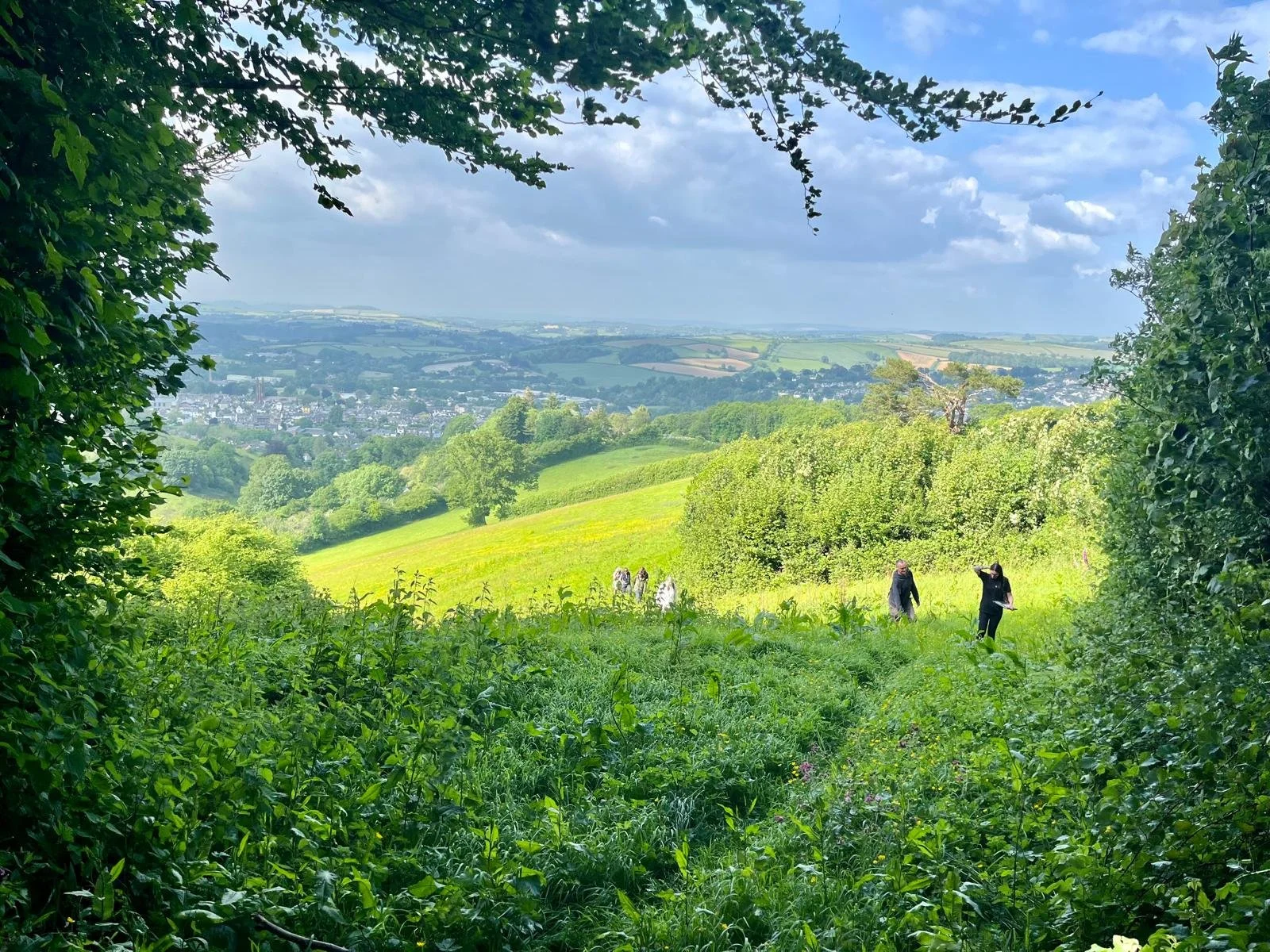
View from the Village site
My name is Aleksandra, and I am part of the Bowden Pillars Future team, involved in the Village Circle and coordinating the design and planning process. I will be telling you how this is unfolding, where we are, what decisions are being made and what questions and challenges are arising along the way.
Three years after the land was formally purchased by Bowden Pillars Future - a non-profit Community Benefit Society - we are crossing another milestone, and it feels like time to share what has been happening.
In meetings, on site visits, over Zoom calls and in late emails, I am now working alongside an architect finalising site plan drawings, a landscape designer sketching how the land will meet the buildings, and a planning expert working through what South Hams District Council will need to see. There are transport consultants, ecology consultants, energy engineers, drainage specialists. Real professionals, doing real work, on a real site.
How did we get here?
Something rare, and worth fighting for
For three years, quietly and carefully and with enormous love, a community of people has been building toward something that very few have managed to pull off in this country, not a housing development, not an eco-village in the abstract, but something more specific, more grounded, more human than either of those things: a real neighbourhood, on a real piece of land near Totnes, where nature, community and farming grow alongside each other.
Projects like this are rare, they are hard, and the planning system can struggle to understand them. As Steph - our comms lead said at one of our public meetings: "I know we've been quiet, but that doesn't mean we're not doing anything." Most of you haven't heard much from us during this time… we were deep in the work, doing the things that don't make good announcements but that make everything else possible.
Here is some of what that work actually looked like.
First - we talked to people
It started with hundreds of conversations - long ones, stretching ones, exciting ones. What kind of homes do people actually want to live in? Where should children play, and how do you design a place where an eighty-year-old and a four-year-old both feel completely at home? How can the design of a house gently shape how people live together and make real social change? How can we live in harmony with nature? We held series of co-shaping sessions over two years where people brought new things for us to consider. More than three hundred people told us what they needed through a survey, and what came back wasn't just preferences about bedroom sizes. It was a picture of how people actually want to live.
Those conversations shaped everything that came next.
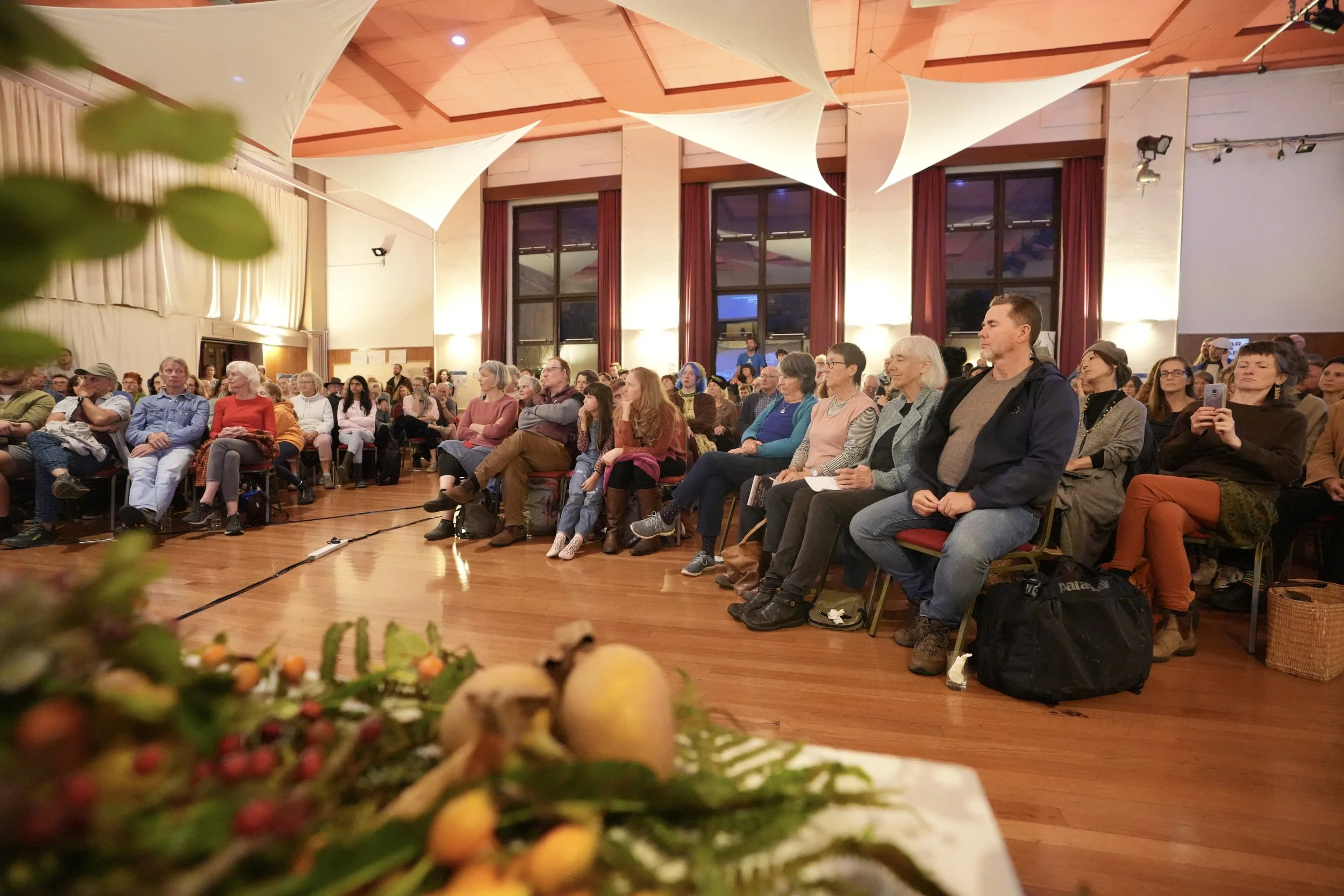
People from Totnes gathered to hear about the project in Civic Hall - September 2023
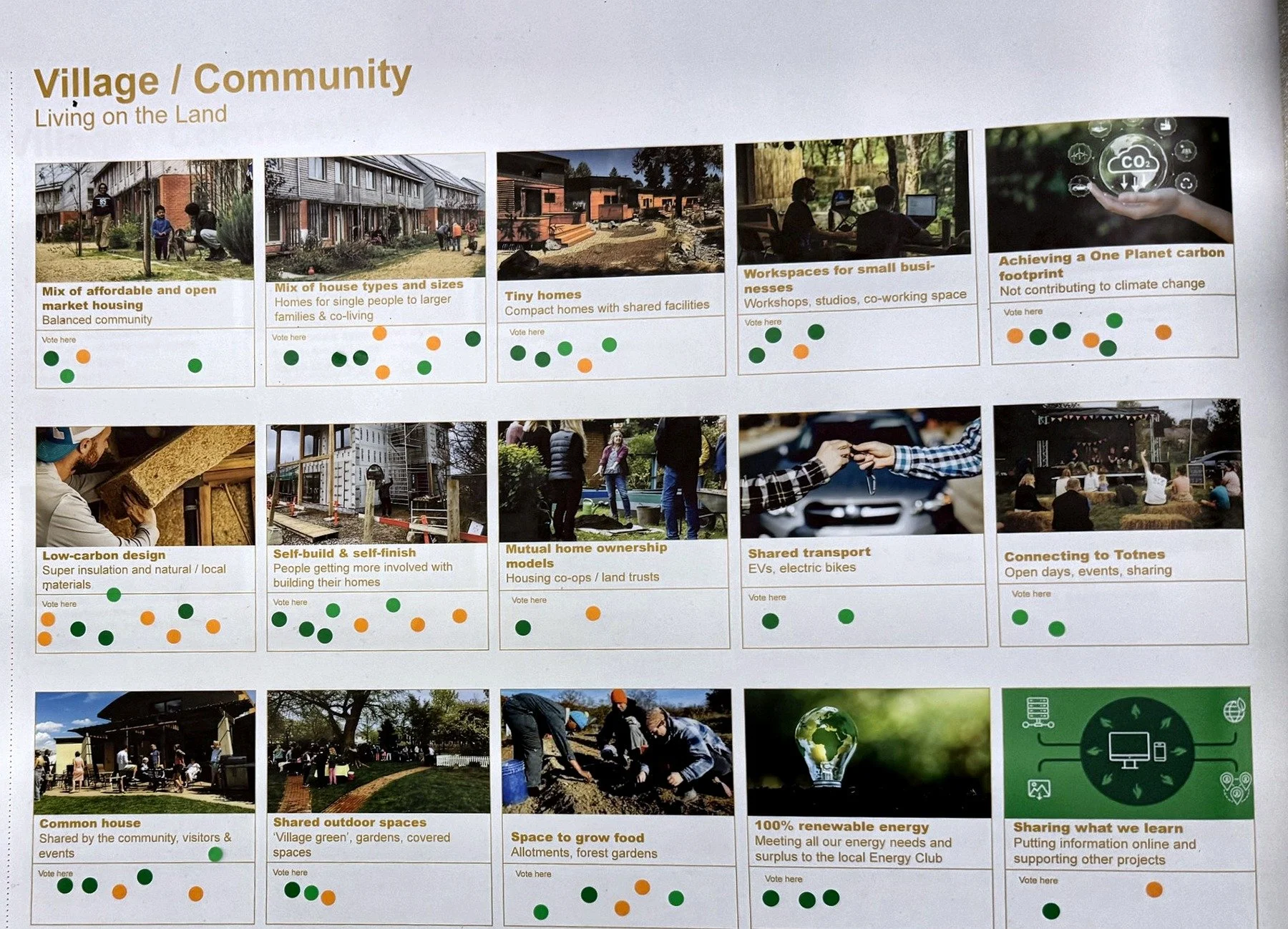
Public voting during BPF Open Days - November 2025
We asked the land
Before we could design anything, we needed to understand the land.
Ecologists came and spent time on the site searching carefully for whoever was already living there. They found bats on the north side of the plot. This changed the layout, because the bats were there first.
Trees across the land were carefully assessed and recorded - those that are healthy and significant, those that need protecting, and those that are too damaged to remain - so that the design could work around the ones worth keeping.
Engineers drilled deep into the ground to understand what the earth could carry for foundations and drainage.
Before any of that, a topographical survey mapped the shape and levels of the land in detail.
And we tried to listen to what the land needed next, after hundreds of years of different sorts of farming. We didn't know most of this when we started, and every discovery shaped what came next.
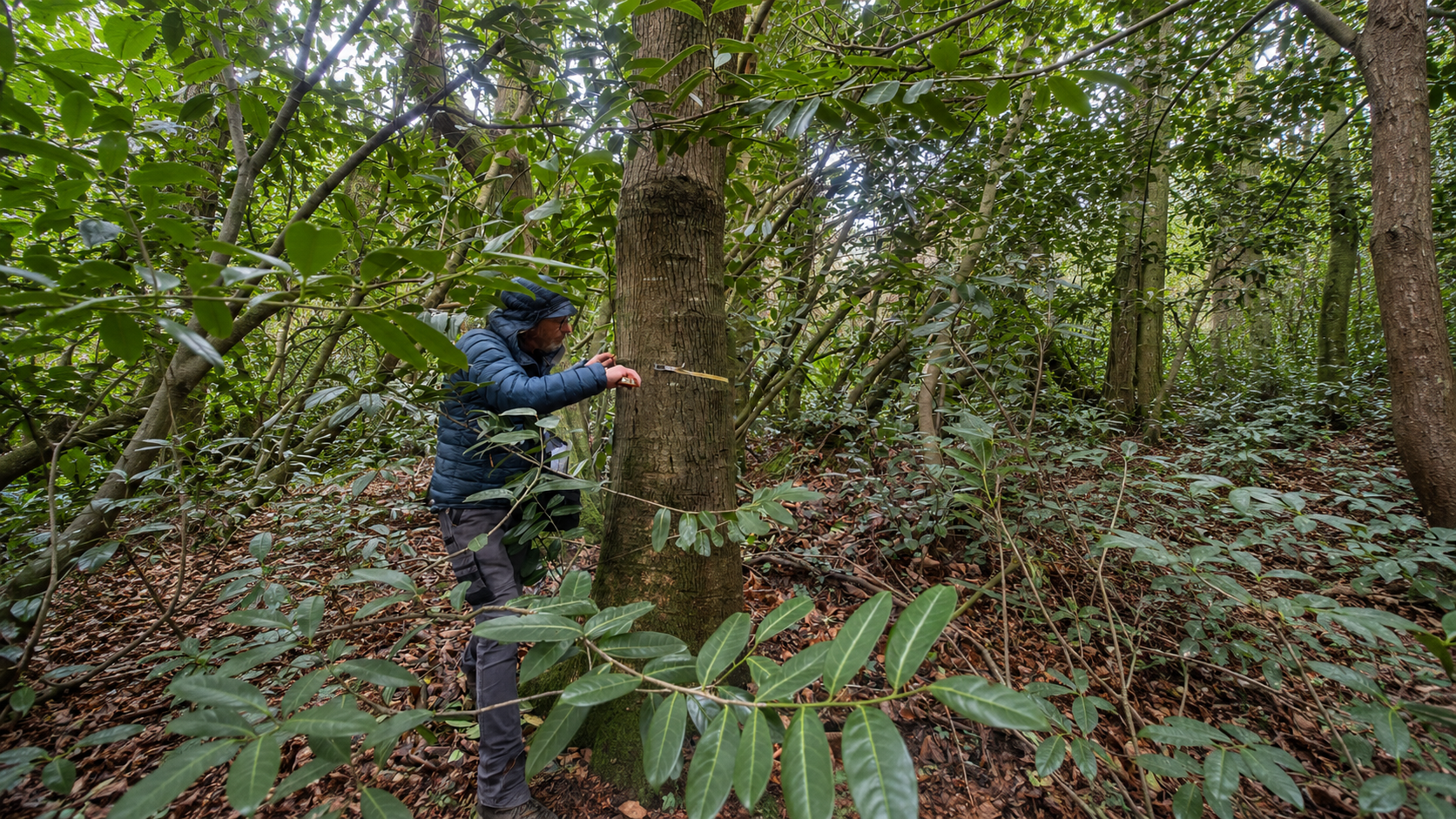
Doug - our tree surveyor and advisor measuring trees on site - January 2026
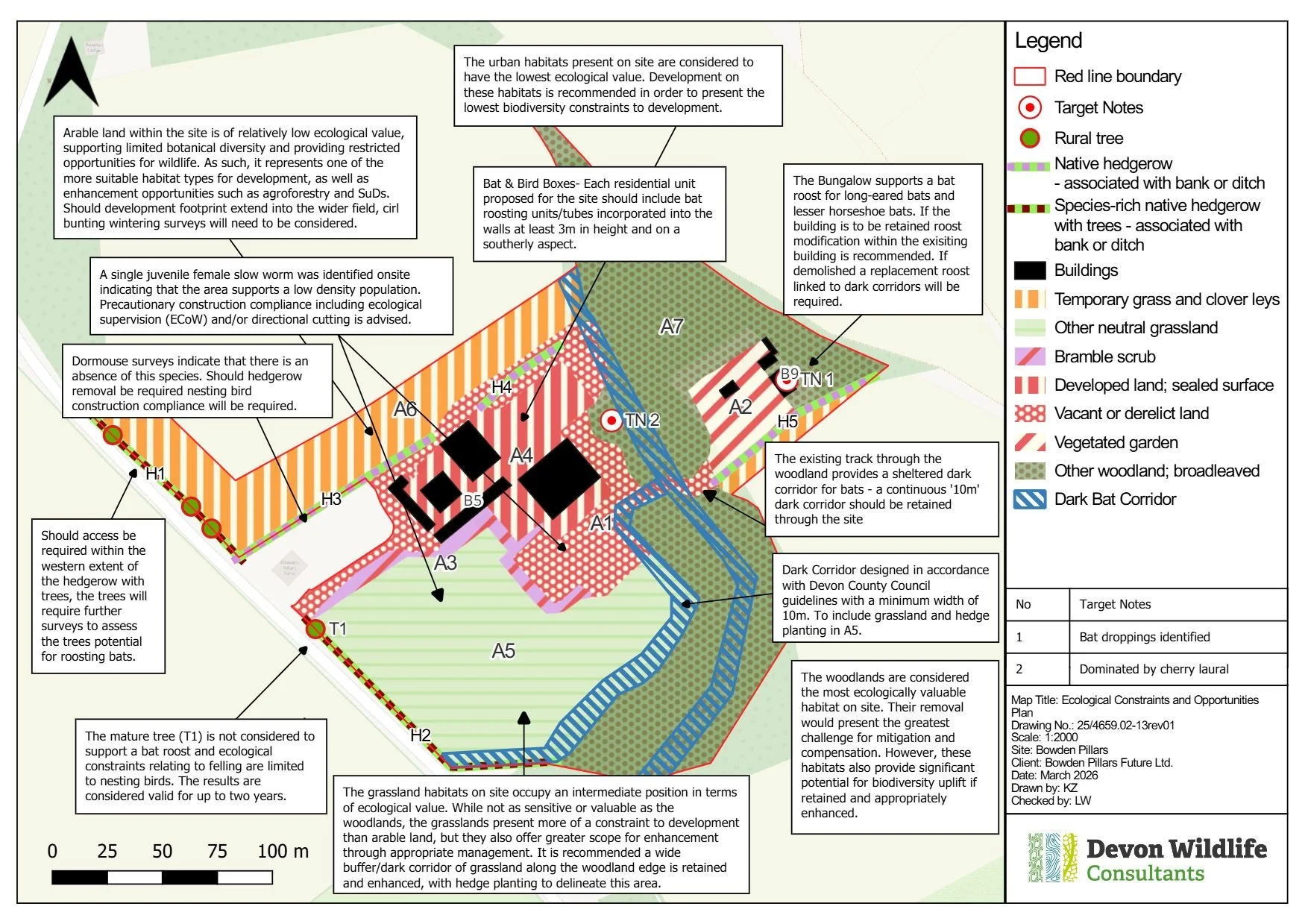
Results of land ecology survey
Co-designing with the architects
Then we brought in the design and planning team. James from Geo, one of the project founders, who first saw the potential for this village, is leading the planning process. Simon from Landstory is leading landscape design. And Team Transition - a collaboration of Transition by Design and Incremental - architects who genuinely understood what we were trying to do - are designing the site and buildings themselves. We also appointed transport consultants, energy specialists, drainage engineers and lighting experts and sat with all of them for months, asking hard questions, working through choices and making decisions that we knew would matter for decades.
But what made this process unusual was that we didn't simply hand over a brief and step back. What we called co-design was something genuinely different: project volunteers working actively alongside the architects and designers with pens in hand, as one team.
During the sessions, we took on roles: imagining being a child on the village green, a teenager wanting privacy, an older person who finds stairs difficult, a disabled resident who needs step-free access everywhere, even a bird or a river, advocating for what each of those beings would need from this place.
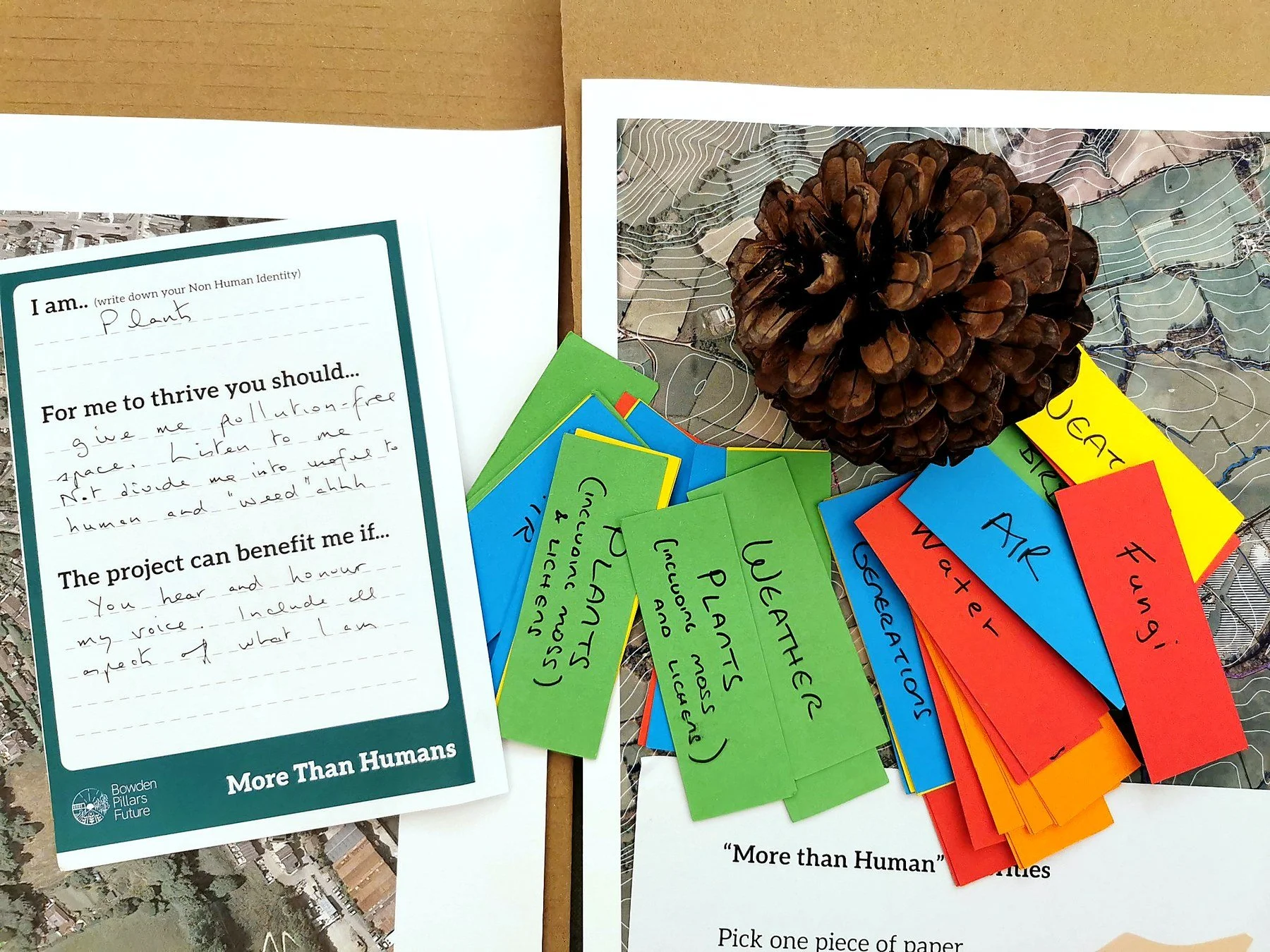
I am … a bird… weather… water. Acknowledging non-humans during the design process.
We held workshops where everyone involved moved things around on the plan together until the layout began to feel right, debating questions like where the Common House should sit, how homes should relate to each other - close enough for community, private enough for peace - and how to make approximately fifty homes feel like a village rather than an estate. The architects also made sure that every decision held up against regulations, and that the form and orientation of the buildings were doing the work of energy efficiency from the ground up.
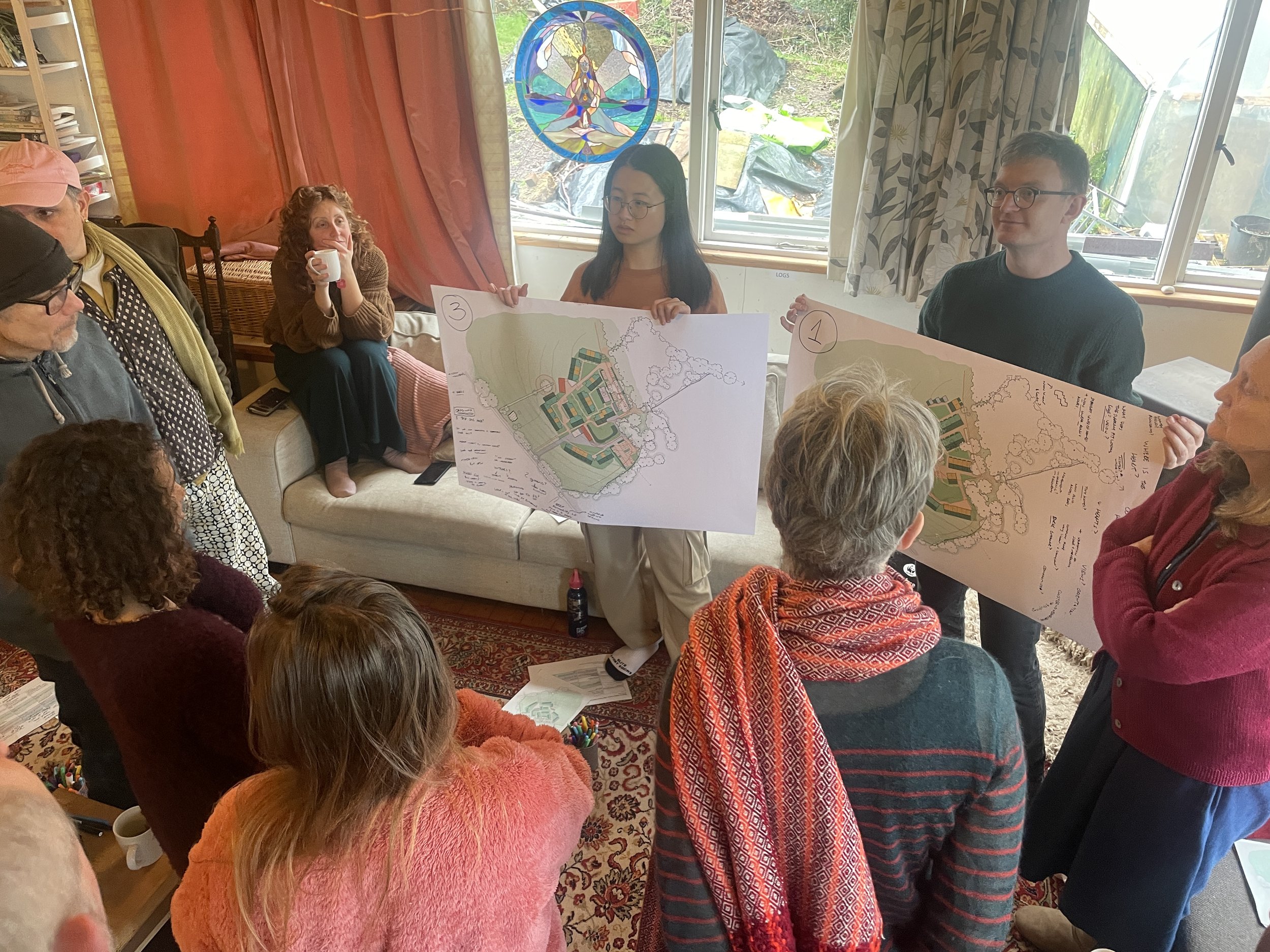
Co-design session - January 2025
We thought carefully about things that only reveal themselves once you live somewhere: how deliveries work for fifty households, and how to make sure every home has access to good natural light.
We also ran financial viability calculations throughout, as a constant check on reality because this project will only work if the numbers hold. The model is tight, but it works, and we hope roughly half of the homes will be offered at affordable prices.
We thought carefully about who gets to live there and how to make it genuinely affordable, genuinely intergenerational and genuinely open. Some of those questions are still live: how the ownership structure will work, how affordable homes will be allocated, and what the gateway criteria will actually ask of people who want to be part of this community. We are working through all of it, and we will share it openly as decisions are made.
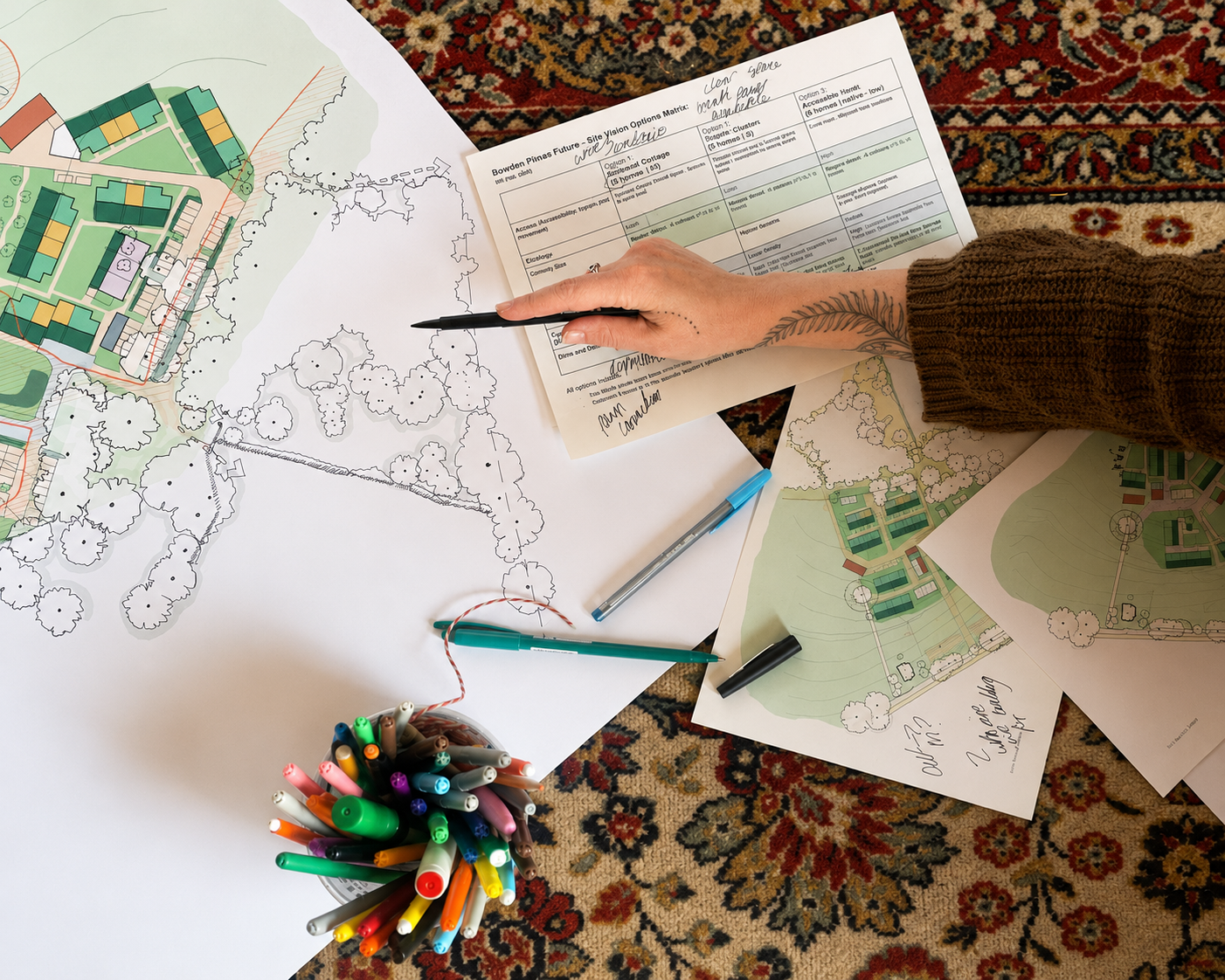
Co-design workshop - January 2025
What has been decided?
This is a question we get asked a lot. A project like this is made up of many questions and micro decisions come along almost daily. Some take five minutes. Others, I will be honest, take several months and at least one complex conversation. Here are some of the decisions we have made so far.
The footprint The village will sit mostly on existing farmyard - the footprint of the old cattle farm barns, which will come down. But we will not be putting housing onto the site of the old bungalow, as it is too valuable for wildlife, and so will take some of the paddock instead. The farmland stays as farmland, and the land for nature and people stays wild. This was one of the easier decisions. It felt obviously right from the beginning.
The car park You wouldn't believe how long a conversation about car parks can go on for. But we got there: cars park at the entrance, and from there you walk. The village itself stays quiet, with vehicles coming in only where genuinely necessary - for deliveries, for disabled access, for emergencies. The village green belongs to whoever is on it.
The homes There will be around fifty homes across three neighbourhood clusters, each with its own character. The homes will be terraced - not in the traditional sense of one long street, but arranged in smaller groups within each neighbourhood, wrapping around shared spaces and responding to the shape of the land. This was a deliberate choice: terraced homes make the best use of the site, and the more homes share walls, the less energy each one needs to stay warm.
The full site plan, coming in June, will show how this works in practice.
Homes will range from one to four bedrooms, and there will also be two co-living houses offering compact individual units with generous communal spaces. This is our considered response to the many people who asked for tiny houses, with a full explanation of why we went in this direction coming soon in a dedicated piece.
This is a cohousing project, where homes are generally smaller reflecting the abundance of shared spaces, indoors and outside. This is an embodiment of one of our guiding principles ‘private sufficiency and public luxury’.
Materials All homes will mainly be built from natural, non-toxic materials - such as timber frame, hempcrete and similar avoiding concrete where possible. This wasn't a difficult decision for us, but it is one that still surprises people who are used to how most new housing gets built.
Energy will come entirely from renewables: solar panels on every roof, and a wind turbine is under consideration. The site has its own water supply from boreholes, meaning the village will be independent of the mains water grid, and the energy system may ultimately allow the village to supply surplus electricity back to Totnes through the local energy club.
Shared spaces. At the heart of the village will be the Common House, and at its core: a community kitchen and a large flexible space for shared meals, gatherings, events, music, dance, or whatever the community needs it to be on any given day. Alongside it, we're imagining a quieter room, somewhere between a library, a working space and an art gallery, and guest rooms for visitors. Outside, a veranda opening onto the village green.
Separate from the Common House, the Food Hub will connect the village to the Bowden Farm Collective and the wider Totnes community - a teaching and processing kitchen, space for community use and for seasonal workshops.
There will also be small business units for residents, a shared workshop and tool store, and a natural playground with informal play areas woven throughout the site. Private gardens will be smaller than in conventional housing, but shared green space runs generously between and around the homes.
The Sanctuary, located in the garden to the north of the village, we imagine as a quiet space for contemplation and relaxation. Perhaps a natural swimming pond, a sauna. This space is still to be shaped, and we are leaving it open for future residents to help define.
Bins and recycling Bins and recycling was, perhaps surprisingly, an extremely popular topic. The decision: shared collection points near the entrance, not scattered outside every front door. The street stays the street.
Views Every home will have a view of nature. This was in the brief from the beginning and we kept it there. Non-negotiable.
Affordability We hope around half of the homes will be either for affordable sales or affordable rent. The financial model is tight, as it always is with genuinely affordable housing, but it works.
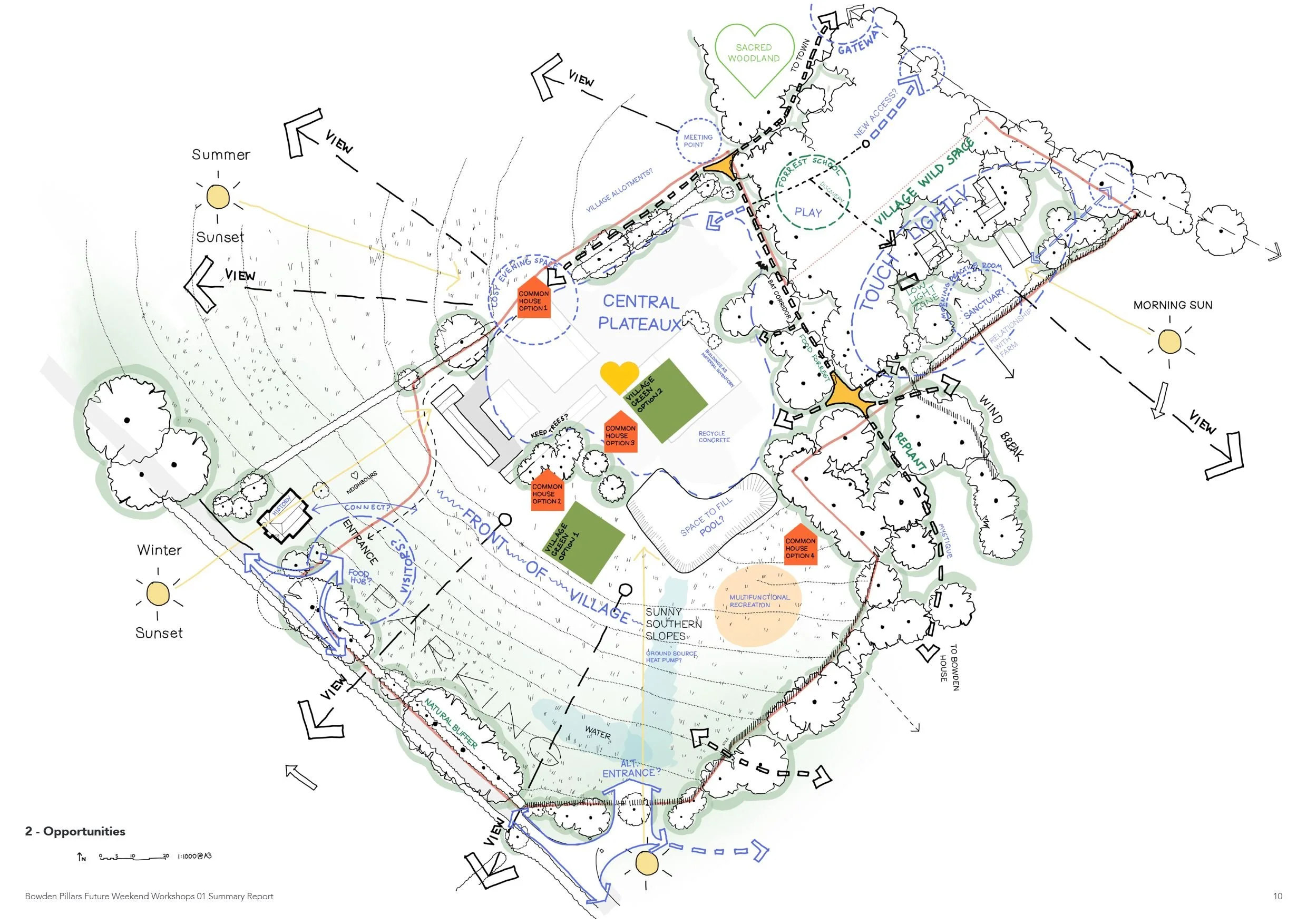
Site opportunities plan developed by architects as part of pre-design process.
The onward journey
The work between now and October is substantial and well-defined and includes:
- detailed floor plans for every home type,
- final energy strategy,
- fully developed design for the Common House and the food hub,
- detailed landscape design integrated with the surrounding farmland and woods,
- detailed drainage proposals,
- final transport strategy,
- all the documents that a planning application of this scale requires.
We are already in formal pre-application dialogue with South Hams District Council - a process that allows us to test our approach with officers before the application goes in and explore ideas together.
We are also working on the approach for affordable housing allocations with the them.
This work costs money, and we need your help to get there. We are currently raising funds for the planning process through a community loan round. If you believe in what we are building and want to play a direct role in making it happen, please take a look at our pledge page and consider lending to the project. More HERE. Every contribution, large or small, moves this forward.
We are also looking for people to help the project. Specifically, we are seeking one or two experienced finance professionals - in strategic finance, development finance, or community and social investment who would like to volunteer two to three hours a week as a Strategic Financial Advisor. You don't need experience in regenerative projects, only the willingness to bring your financial expertise to something that matters. The deadline to apply is 29th May — full details and the role description are HERE.
What's coming next
In the weeks ahead we'll be sharing more of the story behind this project - how the design evolved, what the land told us, and the questions we're still sitting with.
In June we will share the design itself for the first time: drawings, a site plan, and what the homes will actually look like.
More from the journey very soon.