
From India with Love
Interview with Pritam Singh about his involvement with Bowden Pillars Future. April 2026.
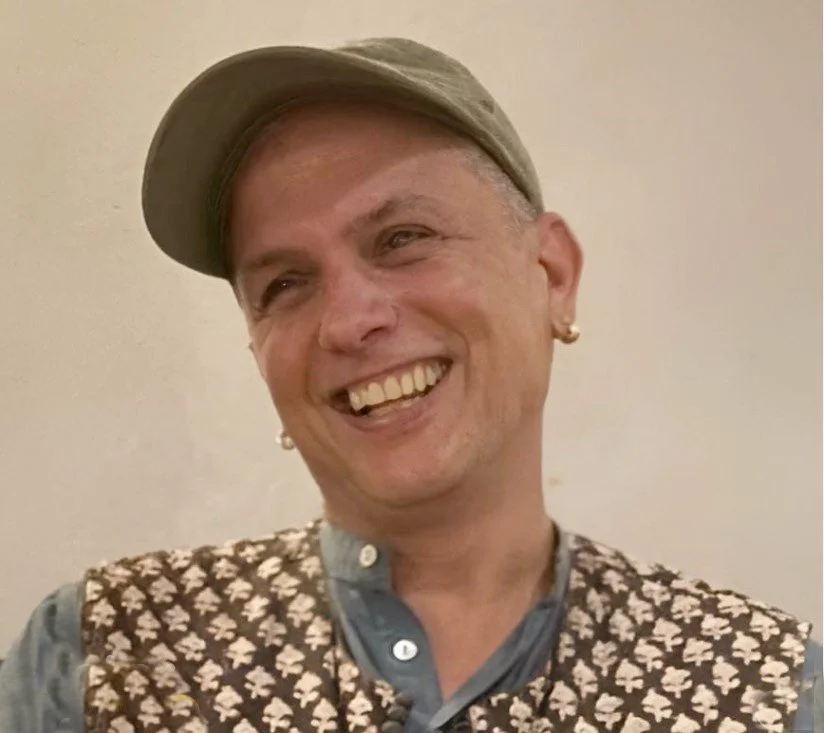
“Land is lacking community, so I wanted to be part of bringing people onto the land in a regenerative, reciprocal way.”
Why did you get involved in the project?
I grew up with philanthropic parents who ran an ethical artisanal business in India to bring about positive change, later going on to study Development Studies at the University of Sussex, looking to improve conditions in the global south. Inherently, I did not align with top-down structures such as how charities are set up. I was drawn to bottom-up approaches, and I wanted to think of businesses as being stewarded. I took over the family business in India soon after university.
I became interested in the longevity of businesses; how they could maintain their ethos over time. As they are generally managed top-down the ethos can be lost or diluted when ownership changes. In terms of the family business that I was then responsible for, I didn’t want shareholders, I wanted the business to be in service, but not to shareholder interests, yet the system in India was not set up for cooperative models. Over the course of 3 decades, the place where our business was based was becoming increasingly urbanised and shaped by capitalism; the air turning toxic, ground water running out, with huge developments going up and no support for the environment. I couldn’t see how the family business could continue under such circumstances. I was drawn to Totnes for the possibilities it holds. Totnes is experimental in its approach to the times we find ourselves in. I was looking for something. I wanted to co-create; I wasn’t looking to lead or be led. I wanted to be an agent for change, and I was looking for a more horizontal structure; something that was not dependent on an individual/s to sustain it over time. The community benefit society model adopted by Bowden Pillars Future answered that need.
How did you find about Bowden Pillars?
It was my friends who have the Zero Waste shop (Earth Food Love) at the top of town. Richard and his family live at Bowden House Community. I went along to the initial meetings which included James Shorten (Bowden House), and Marina O’Connell (Apricot Centre) and felt good about the land and the project, so I became a lender.
How else did you choose to get involved?
So first some background. I’m a director of School Farm (Dartington) and I studied Regenerative Agriculture at the Schumacher College, so I am part of a community of growers, and I wanted to be of service and was looking for opportunities. I felt that land needs to be managed, to be stewarded.
Food is everyone’s need so I see this as an opportunity to connect people to the land. Land is lacking community, so I wanted to be part of bringing people onto the land in a regenerative, reciprocal way – beneficial to land and people.
I’d dreamt about this a lot in relation to the school farm project. I feel that where there is appetite then people need to be on the land, stewarding it, I like to look at the land at Bowden and its proximity to the local community through the Permaculture principles of zoning, so where, for example, I see this land as Zone 2 land, areas visited once or twice daily (e.g., market garden and horticulture of various kinds), I see land that is further away from Totnes as Zone 3, that is where we as a community we could look to meet our needs for things that need less daily tending, such as grain growing that needs less people and can be done using tractors, for example . There are a lot of people locally with the appetite to be on the land and currently not many opportunities.
So, I chose to be involved with the Farmland aspect of Bowden Pillars Future, although I am also part of some other areas of the project.
What have been some of the challenges so far?
There are two main challenges that I see as affecting every project:
Economic (the need to resource ourselves) – and this will be on-going.
People who grow food are never paid enough, and people do not allocate enough of their income to food, as they would have done in the past.
We need to pay for the land, and pay people back their loans
Sustaining the project – tending needs at the collective and the individual level
Human relationships – communication is an on-going place of learning – tending to relationships, perhaps through NVC (Non Violent Conflict Resolution), and/or mentoring.
And the highlights?
There are three highlights for me
When we are all in the same room, embodied, face to face
Seeing the six new growing projects starting on the land
Beauty – walking on the land, seeing it come to life since we’ve brought it in with the community There is a spot on the land which I have visited and observed three times. It’s the field which has the sea view, it’s also the highest point on the land, and it looks down over Totnes.
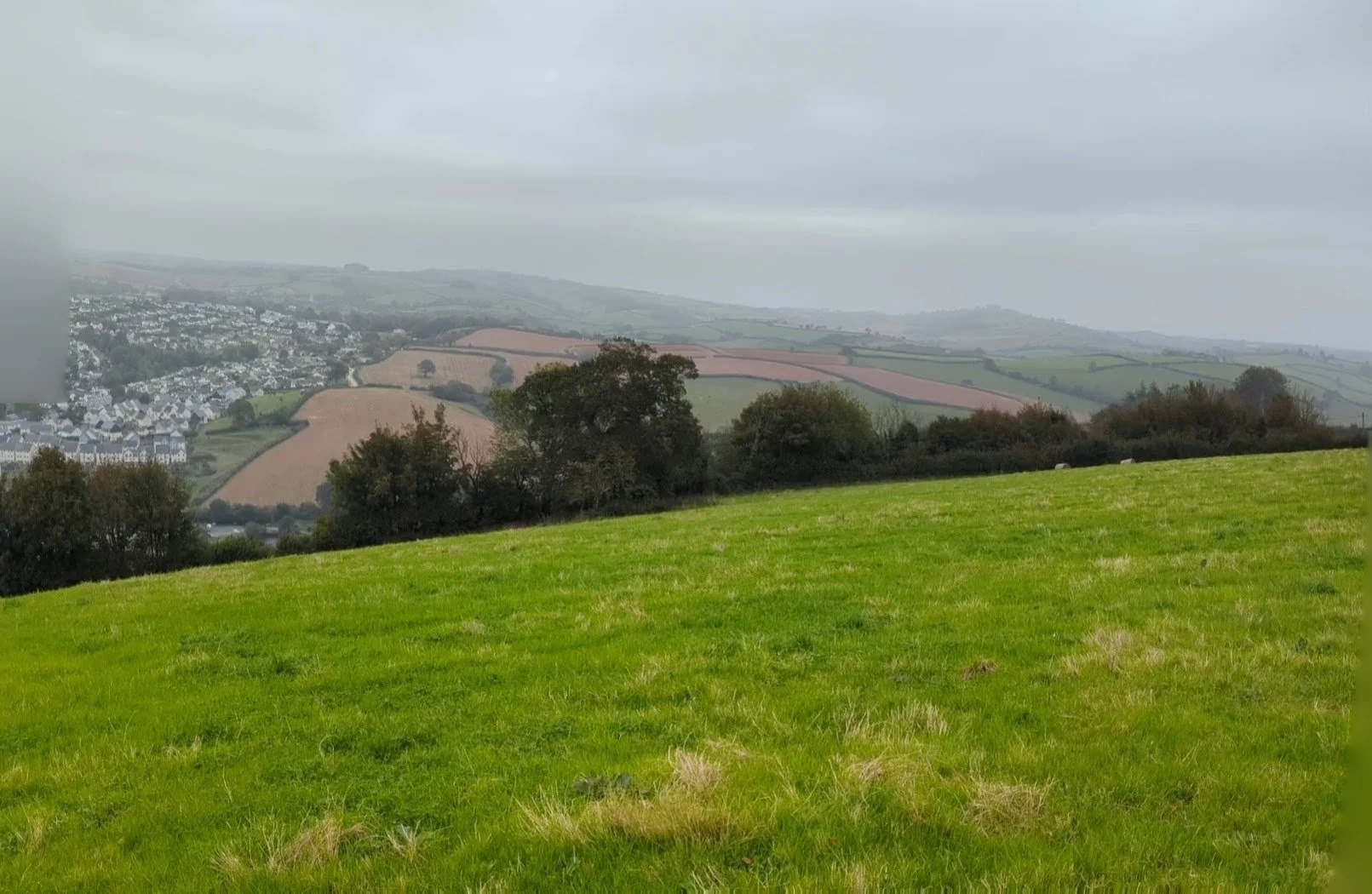
Before we bought the land - dreaming of the possibility of stewardship but not wanting to get too imaginative as it hadn’t been bought yet
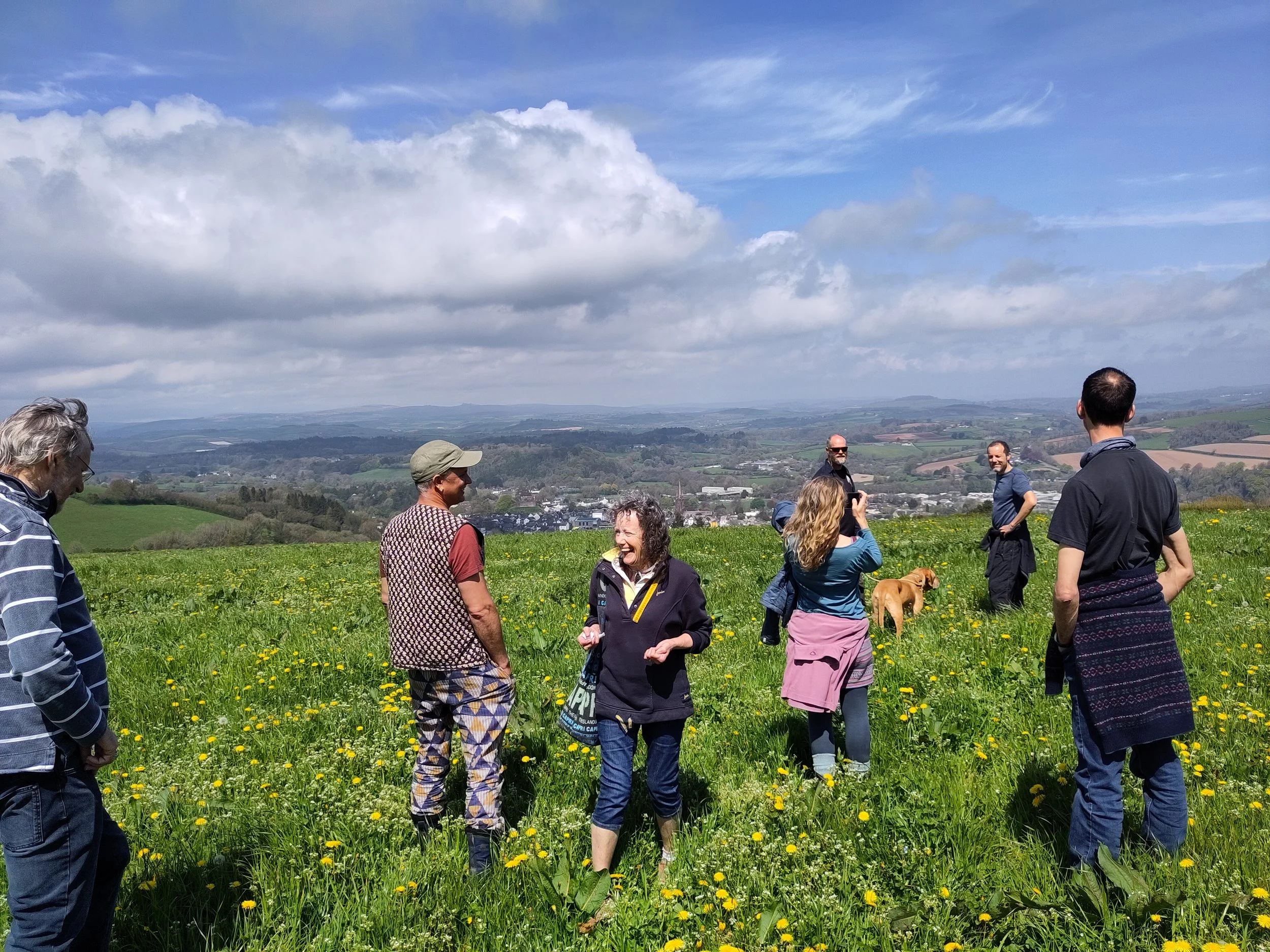
Just after we bought the land – the feeling of joy
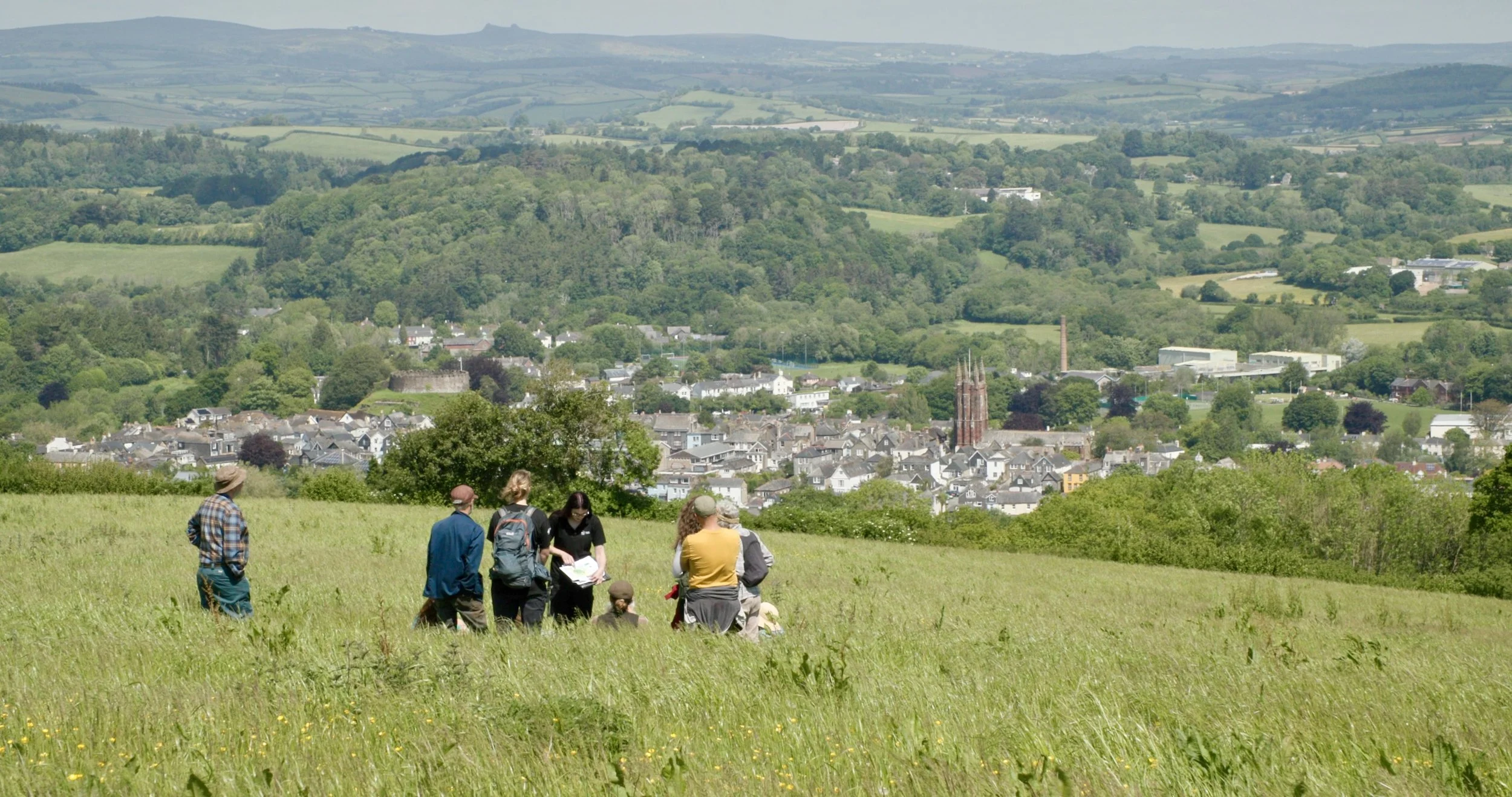
Seeing it after it had evolved as a part of farmland, after the tree planting, when regeneration had started.
What are your aspirations for the project?
For me this is not an individual desire. I see the project as connecting as many people as possible to the land. We will have succeeded in this when the local community (Totnes and the local area) all have a reason to be there, something being met for each person in some way; a place of hope, joy and celebration. For that we need to create many diverse opportunities for people to come onto the land – not limited to involvement in the project itself. My wish is for it to be mixed use, valued and loved by all, and with nature thriving. Until you love something you are not going to protect it.
How would you define the project in one word?
Reassuring - Life – Alive – Love - Alignment
It’s difficult to express the full range of different qualities of love in the English language.
We are stewarding an ecosystem at Bowden Pillars Future. It’s a collective. We have been conditioned in the modern era to think in individualistic ways, but life on earth thrives in interdependent collectives i.e. eco-systems such as marshland, coral reefs or the amazon rainforest. Not all life can thrive in all ecosystems. Each ecosystem has its optimum community of interconnected beings that best support one another and in doing so help a place reach its potential. The rainforests of the Amazon have relatively poor soil, yet they are one of the most abundant places on earth, due mainly to the diversity of its interdependent life. What we seek to steward at Bowden Pillars Future is a diverse, resilient and abundant eco-system that’s striving for its potential.
