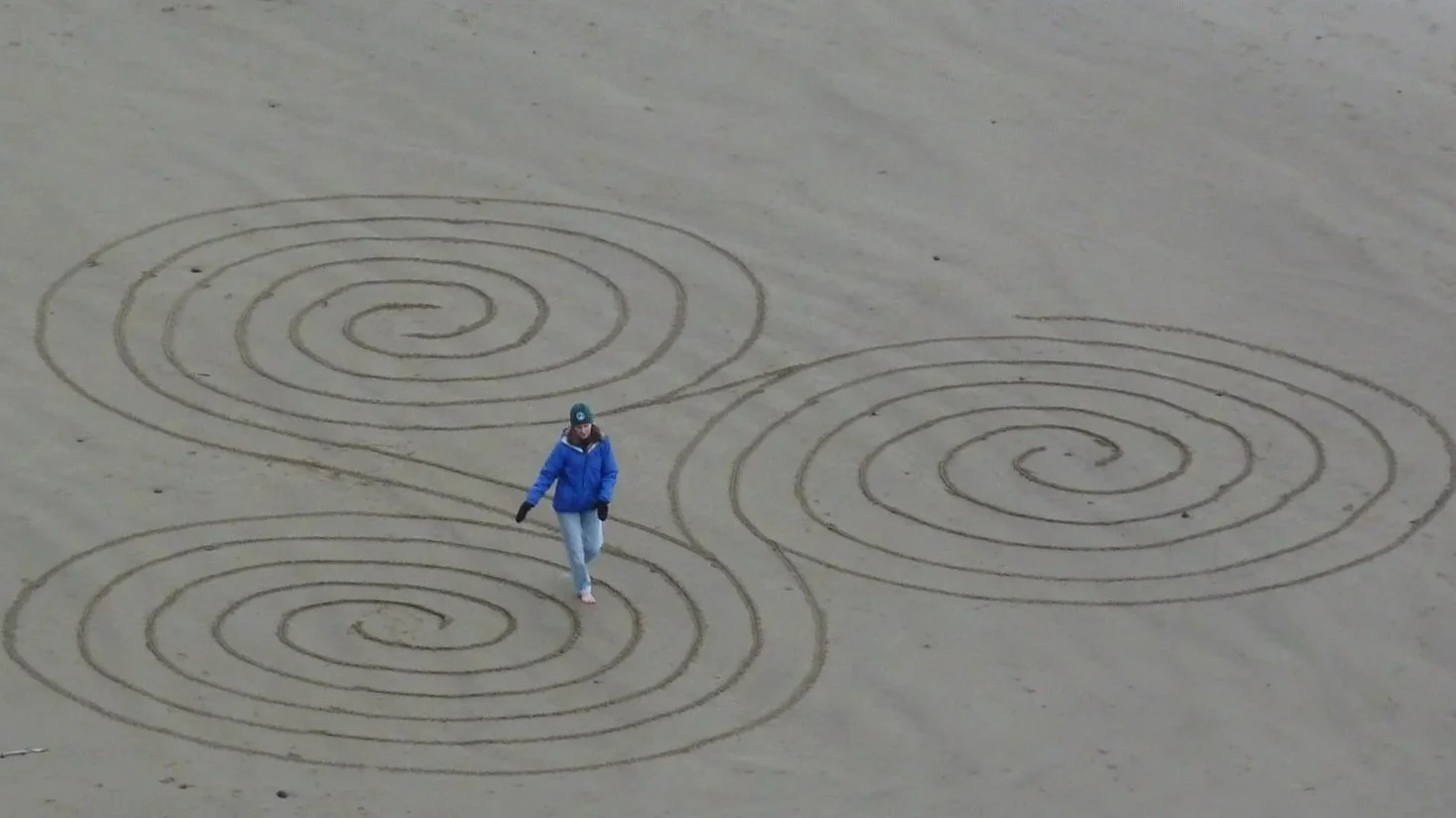
Project Journal: Going Around in Circles; regenerative learnings

Written by Steph
Going around in circles.
Or maybe spirals.
We repeat ourselves. One person speaks to me, someone else picks it up, and eventually it circles back again, often to the same person who sparked it. The same conversation 10 times in one week. An email to a contact who heard from someone else just a few weeks ago. Or a document discovered that says everything I’m thinking, dated 6 months ago. Or the same question comes round to meet us in the meeting we’d planned to meet the question from last week.
I came to this project from a corporate world, one obsessed with progress, solutions, deliverables and ‘closing loops’. That culture, I begin to see now, was all about finalisation, clarity, directiveness and solutions. And for solutions you need decision making fueled by power and authority. These are power over processes rather than relationships with. Sounds obvious maybe. Any yet so often in this project I ask myself;
Why do I feel like I’m repeating myself?
Why do I feel we’re going around in circles?
The obvious answer. Because nature doesn’t move in straight lines. And expecting it to is precisely why I joined Bowden Pillars Future.
The reality is, when I allow myself to drop the need for control or the judgements associated with ‘repetition’, there’s more going on than I realise. Just as I catch myself thinking Are we getting anywhere... something shifts. We move, but not in the way I once understood progress. There’s no sharp corner, no triumphant ‘next stage’ The road isn’t even straight. There is still celebration, but it doesn’t say ‘we made it’. It says ‘we are here’.
The déjà vu of this work, I’m realising, is something I can see differently, and a celebration in itself.
Don’t worry about sounding professional. Sounds like you. There are over 1.5 billion websites out there, but your story is what’s going to separate this one from the rest. If you read the words back and don’t hear your own voice in your head, that’s a good sign you still have more work to do.
Be clear, be confident and don’t overthink it. The beauty of your story is that it’s going to continue to evolve and your site can evolve with it. Your goal should be to make it feel right for right now. Later will take care of itself. It always does.
Before last week, regenerative felt like a confronting word — something I skirted around without knowing why. Then came a workshop with Mellissa Kinnear of Transition by Design. Our whole design team sat there with wide eyes: some serene, some lit up in recognition.
My jaw simply dropped. There was a pause I surrendered to completely — the kind where time slows down and your body finally exhales.
In these early stages of my own transformation — learning myself while learning the project — here’s what I’m reminding myself…
1. There is no such thing as complete.
I have to keep dropping the idea that anything can be fully finalised, neatly wrapped, or truly “done.”
This project reaches far beyond us — and beyond anything we can imagine today.
2. All connection is community-building.
Meetings, updates, check-ins… they’re often just scaffolding for something deeper.
We are building community in disguise.
3. The right kind of effort.
Not force. Not push. But freedom, movement, responsiveness.
4. Ebbs and flows — not ups and downs.
Everywhere I turn, I encounter a discrepancy, an incoherence, a contradiction.
In my old life, that meant dysfunction. Here, it’s simply the truth of a living system.
The energy matures, withdraws, concentrates, expands. It’s not chaos — it’s tide.
5. Repetition is evolution.
A personal frustration of mine: repeating conversations.
But the project is full of synchronicity and delightful recognitions.
Yes, we’ve had this conversation before — and we’ll have it again —
but each time it moves a fraction, shaped by someone’s unique perspective.
That’s not stagnation. That’s emergence.
6. It isn’t graspable.
Without traditional leadership structures, the journey feels unfamiliar — even scary.
It’s impossible to hold all the moving parts.
But maybe that’s the point.
From the inside of my small piece, things repeat because we are unlearning centuries of assumptions about how we “should” live.
7. Reflecting and resourcing.
I left the corporate world because it was making me unwell.
I’m not alone in that.
Regenerative practice is not just a professional approach — it’s personal medicine.
Sociocracy as a Living Expression of Regeneration
Something else is becoming clear to me the longer I sit inside this work: Sociocracy isn’t just a governance model — it’s a regenerative practice in action. Its circular structures, consent-based decision-making and emphasis on equivalence reflect the patterns we see in ecosystems.
Instead of centralised power, it offers distributed intelligence.
Instead of certainty, it values feedback.
Instead of “decide and deliver,” it asks us to listen, adjust and evolve.
This mirrors exactly what regeneration teaches: that life moves in cycles, in relationships, in responsive shifts. Sociocracy gives us a way to organise that feels alive — a framework that supports emergence rather than suppressing it.
It allows us to practice, in the everyday rhythms of meetings, roles and decisions, the very principles we’re trying to honour in land, community and culture. It is governance as relationship — aligned with the earth, not imposed upon it.
Conclusion: A Different Kind of Progress
These reminders are both reassuring and radical.
They point, unsurprisingly, to the true value of Bowden Pillars Future:
its longevity, its ambition, its commitment to harmony with nature.
Some parts of this I still struggle to understand.
Other parts I feel in my bones.
Like the latent phase of labour, this process is not linear.
Pressure, force, over-planning or over-analysis won’t bring it forward.
My biggest learning right now is that I can soften.
I can allow space.
I can recover my sense of what I am part of.
For now, I’ve landed in a place of balance — trusting the process, allowing natural evolution, recognising the value of our individual roles while surrendering to what wants to emerge.
I can no more “understand” this project in its entirety than I can understand how a pinecone forms on a tree — but I can stand in wonder as it does.
Project Journals are written by project members....