
The Forest Takes Root at Bowden Pillars
Three winters in, and the forest is already beginning.
What started in winter 2023/24 as a pilot planting of 2,500 native trees has grown into one of South Devon’s most ambitious landscape restoration efforts. In winter 2024/25, a further 7,000 trees were planted. Now, in winter 2025/26, another 10,000 trees are going into the ground, with planting still underway.
Across 75 acres on the edge of Totnes, oak, birch, rowan, holly, alder, willow and hazel are steadily taking root. Former sheep pasture is becoming something very different — a landscape designed to evolve into temperate rainforest over the coming decades.

In decades to come, this land will look very different.
From Pasture to Temperate Rainforest
Temperate rainforests, also known as Atlantic or Celtic rainforests, once covered large areas of Britain’s western regions. High rainfall, humidity and relatively stable temperatures create the conditions for these moss-rich, lichen-laden woodlands. Today, after centuries of clearance and fragmentation, they cover less than 1% of the UK.
Bowden Pillars sits within the Dart Valley landscape, close to remnants of ancient woodland. The long-term vision is that around 70% of the site will become tree cover, interwoven with open glades, woodland rides and wildflower-rich meadows. This mosaic structure supports both woodland species and open-habitat wildlife, increasing overall biodiversity.
The ecological gains begin long before the canopy closes. Reduced grazing pressure, improved soil health and the removal of artificial fertilisers create immediate benefits for insects, birds and small mammals. Moths, butterflies and bees respond quickly. Farmland birds such as yellowhammers and barn owls benefit from the changing structure of the land.
Over time, as the woodland matures, the conditions for true rainforest ecology will develop - damp, layered and biodiverse, connected into the wider Dart Valley network.
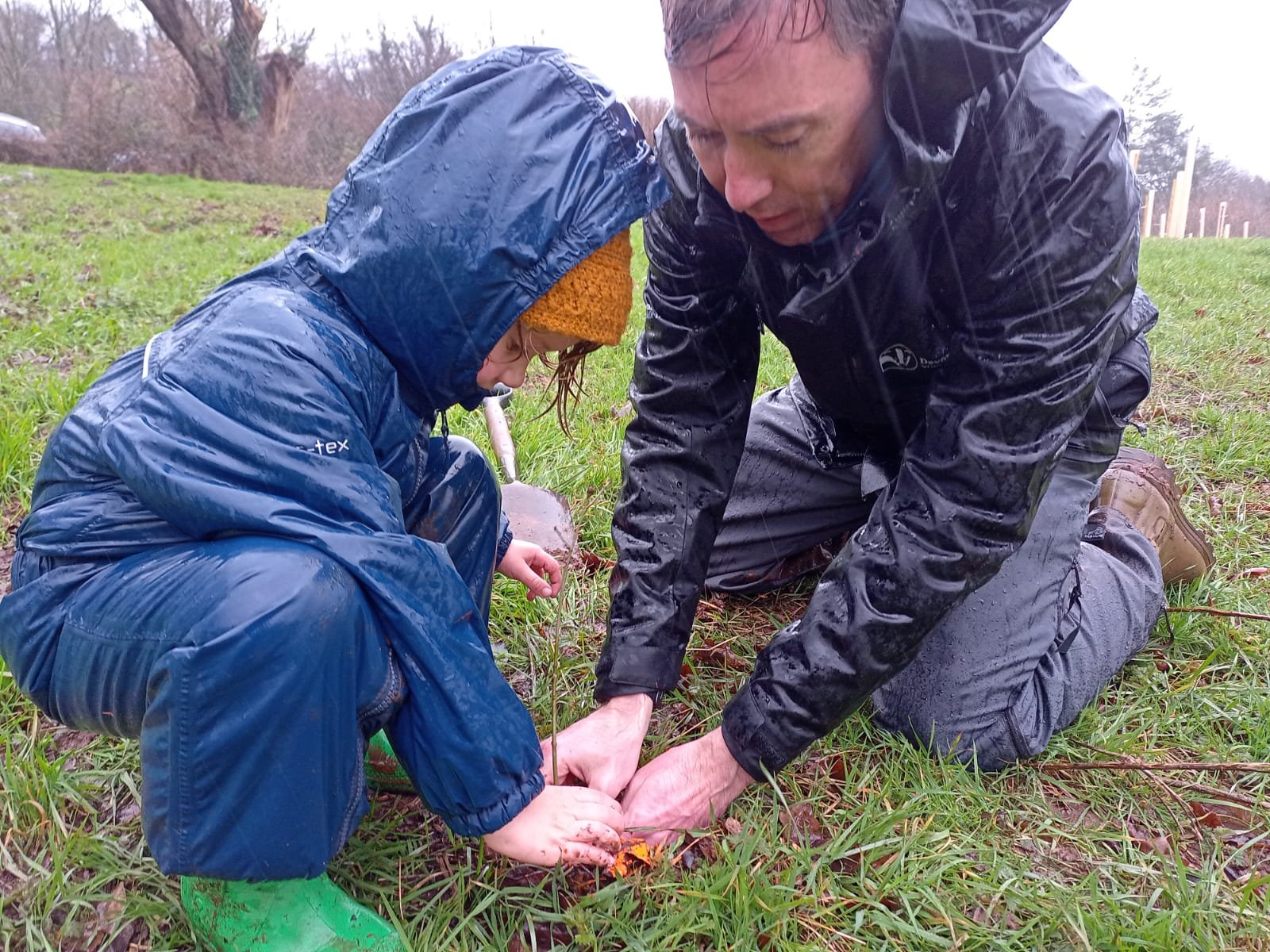
Planting the Future
A 105-Year Commitment
The transformation is being delivered by Devon Wildlife Trust through a 105-year lease, as part of The Wildlife Trusts’ national Atlantic rainforest recovery programme in partnership with Aviva.
But the forest is not being planted by machinery alone.
Tree-planting days have brought together volunteers of all ages, learning directly from Devon Wildlife Trust what it takes to establish a rainforest. On 20th February this year, another community planting session saw people gathering once again — meeting oak, birch, rowan and holly not as abstract species, but as future neighbours.
“The mature temperate rainforest will take several decades to become established, but the gains for nature will be much swifter. The mix of young trees amongst pasture and hedges, and our commitment not to use pesticides or artificial fertilisers, is already creating better conditions for wildlife. It’s exciting to see Bowden Pillars beginning its transformation into a place that is both a home for nature and a vital resource for local communities.”
The trees themselves are locally sourced and grown, many raised from seed collected in ancient woodlands on Dartmoor and nurtured in community nurseries by Moor Trees. Instead of plastic guards, biodegradable tree tubes made from timber industry offcuts are being used to protect young saplings from deer and rabbits.
Nature at the Heart of Bowden Pillars Future
The rainforest does not stand alone. It sits alongside regenerative farmland and the proposed village at Bowden Pillars, forming a landscape-scale approach to settlement rooted in ecological recovery.
Nature recovery is intended to be embedded across the entire site — through landscape-led design, ecological corridors, habitat-rich public spaces, sustainable drainage and permaculture principles shaping gardens and shared areas.
Through the Nature Circle, future initiatives will include citizen science and a community Bioblitz to gather biodiversity data across the wider village and farmland areas, complementing the rainforest restoration work.
This is a 100-year story. The trees planted over these past three winters will not reach maturity in our lifetimes. But their impact begins now — in the soil, in the insects, in the changing structure of the land.
At Bowden Pillars, the forest is no longer an idea.
It is already growing.
Read more :